
Published by City Cooling Engineering | Aircon Technicians in Singapore | Updated April 2026
What Singapore Homeowners Should Take Away
- Refrigerant does not get ‘used up’ — if you need a top-up, you have a leak.
- Fixing the leak costs roughly the same as two repeat top-ups, and saves far more over 12 months.
- Always ask for pressure gauge readings and a written service receipt — these are the minimum standards of a legitimate job.
- R32 is the current standard for new Singapore units; R22 systems face increasing costs and limited support.
- City Cooling’s same-day aircon gas refill service covers all refrigerant types, all brands, islandwide.
If your aircon needed a gas top-up 3 months ago and isn’t cooling again today, you don’t have a gas problem — you have a leak problem.
This is one of the most misunderstood (and most expensive) aircon issues in Singapore. Most homeowners discover the hard way: a cheap top-up without leak detection turns into four top-ups a year — and eventually, a compressor replacement.
In this guide, we explain how refrigerant actually works in a Singapore climate, why the gas keeps disappearing, how to calculate what ignoring the root cause is really costing you, and — critically — how to verify that any technician you hire actually did the job properly.
1. How Refrigerant Works — And Why It Disappears
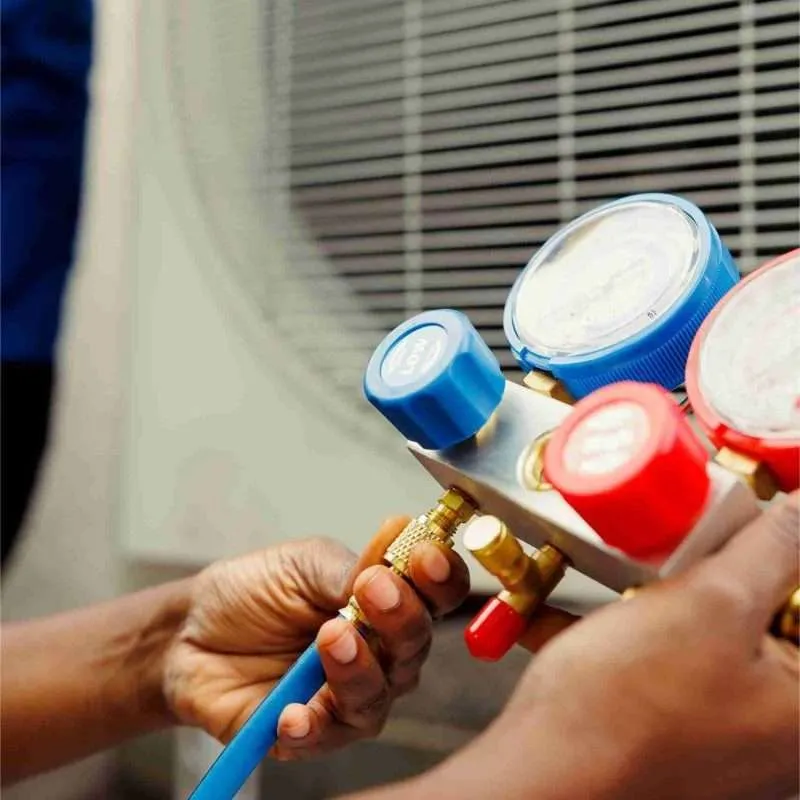
Refrigerant is not a consumable fuel. Unlike petrol in a car, a properly sealed aircon system should never need a top-up — the refrigerant circulates in a closed loop indefinitely. If your system is losing gas, there is one explanation: a leak somewhere in the refrigerant circuit.
The Refrigeration Cycle in Simple Terms
Your air conditioner moves heat — it doesn’t generate cold. Here is how:
- The refrigerant starts as a cold liquid in the indoor evaporator coil. Warm room air passes over it, causing the refrigerant to absorb heat and turn into gas.
- That gas travels to the outdoor compressor, which pressurises it into a hot, high-pressure vapour.
- The hot gas enters the outdoor condenser coil, releasing heat into the outside air and turning back into liquid.
- The liquid passes through an expansion valve, cools down, and returns to the indoor unit to repeat the cycle.
Interrupt this cycle with insufficient refrigerant and the compressor has to work harder, overheats, and — left unchecked — fails entirely. In Singapore’s year-round heat, the stress on components is significant.
2. The Real Cost of Ignoring a Refrigerant Leak
Here is where Singapore homeowners consistently under-calculate. A single gas top-up feels affordable at $50–$150 . But the full picture tells a different story:
| Scenario | Short-Term Cost |
| Top-up only (leak ignored) | $50–$150 |
| Detect & fix leak + top-up | $150–$200 once |
| Compressor failure (from no gas) | $600–$1,500 replacement |
The key insight: fixing the leak plus topping up costs roughly the same as two repeat top-ups — but the savings over 12 months are substantial. And that does not include the electricity cost of an inefficient, low-gas system running your bills up daily.
NEA data indicates that aircons running at suboptimal refrigerant levels consume up to 20% more electricity. For a 3-room HDB household running aircons 8 hours a day, that can add $30–$60 per month to the power bill.
3. Signs Your Aircon Needs a Gas Top-Up Right Now
Not all symptoms are obvious. Here is a quick reference for homeowners:
| 🚨 Warning Signs — When to Call a Technician |
| Weak airflow or warm air even on the lowest temperature setting |
| Ice forming on the copper pipes or indoor unit (paradoxically — frozen coil = low gas) |
| Indoor unit leaking water more than usual (drainage triggered by coil freezing/thawing) |
| Hissing or bubbling sounds from the refrigerant lines |
| System runs continuously but the room temperature never drops to the set point |
| Electricity bills rising with no change in usage patterns |
HDB vs Condo vs Landed — Does Property Type Matter?
Yes, in a practical sense. HDB units typically have a single split system per room. A gas top-up on a 4-room flat usually means servicing 2–3 individual units — costs add up quickly if a leak is undiagnosed across multiple units. Landed properties and condos often have multi-split or ducted systems, where a single refrigerant circuit serves multiple indoor units — one leak can affect the entire system’s performance.
4. R22, R410A, and R32 — What Singapore Homeowners Need to Know in 2026
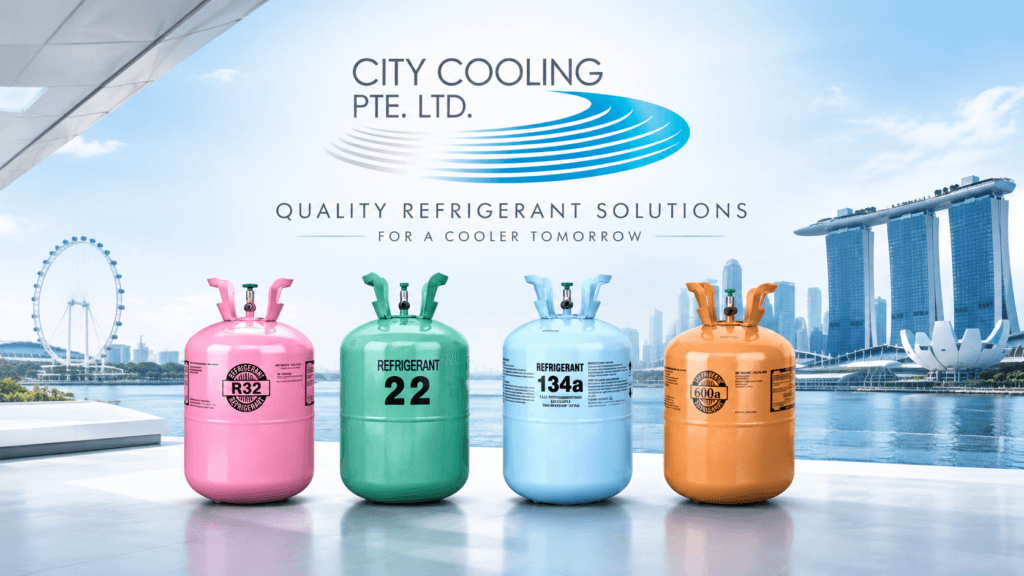
The refrigerant type in your aircon matters both for cost and for future-proofing. Here is the 2026 Singapore picture:
| Refrigerant | System Type | Price (SGD) | Eco Rating |
| R410A | Single Split | $ 80-120 | ★★★★☆ |
| R32 | Single Split | 120-150 | ★★★★★ |
| R22 | Single Split | 50-80 | ★★☆☆☆ (phase-out) |
| R410A | Multi-Split | 80-120 | ★★★★☆ |
| Central / Commercial | All types vrv | 380-580 | Varies |
Why You Cannot Swap Refrigerant Types
A question that comes up frequently: ‘Can I upgrade my R22 system to R410A?’ The short answer is no. Each refrigerant runs at different pressures and requires different compressor oil. Retrofitting is not recommended and can damage the compressor. If your system uses R22, the more cost-effective long-term move is to consider a unit replacement — especially since R22 supply is restricted globally, making it progressively more expensive and harder to source.
R32 — Singapore’s Current Direction
Most new aircon units sold in Singapore since 2020 use R32. It has a lower Global Warming Potential (GWP) than R410A and is approximately 10% more energy-efficient. Its higher flammability classification (A2L) means systems using R32 must meet specific installation and ventilation standards — which is why you should always use certified technicians for R32 service work.
5. What a Proper Aircon Gas Top-Up Service Looks Like
One of the most common complaints in Singapore’s aircon servicing industry is customers not knowing whether they received a legitimate service or were simply charged for a technician connecting a gas cylinder for a few minutes. Here is what a proper service involves:
- System diagnosis — technician checks outdoor unit operation, listens for abnormal sounds, inspects copper pipe connections
- Pressure test — manifold gauges are connected to measure suction and discharge pressure. The readings tell an experienced technician exactly how much refrigerant is missing and whether the system is holding pressure.
- Leak detection — using an electronic detector or UV dye to locate the source of loss. This step is what most cheap providers skip.
- Leak repair — brazing, sealant application, or component replacement depending on severity.
- Gas refill to manufacturer specification — quantity and pressure targets are model-specific, not a rough estimate.
- Post-refill pressure hold test — confirms the repair is sealed and gas is retained correctly.
- Performance verification — indoor unit temperature delta is checked (supply air should be 8–12°C below return air in a functioning system).
6. How to Verify the Job Was Done Correctly (Consumer Protection Guide)
This section exists because Singapore homeowners have no easy way to independently validate that their gas top-up was performed to standard. Here is a practical checklist:
| ✅ How to Verify Your Aircon Gas Top-Up Was Done Correctly |
| Step 1: Ask for the pressure gauge reading BEFORE and AFTER service. A good technician will show you both on a manifold gauge. |
| Step 2: Check that the outdoor compressor unit is running and not making unusual vibrations or loud clicking. |
| Step 3: Feel the air from the indoor unit — it should feel noticeably cooler within 10–15 minutes of a proper refill. |
| Step 4: Ask if a leak test was performed. If not, the root cause may still be unresolved. |
| Step 5: Request a written service receipt stating the refrigerant type used, quantity topped up, and warranty period. |
Red flags to watch for:
- Technician does not connect a manifold gauge at all
- Service completed in under 10 minutes for a full top-up and leak check
- No written documentation of refrigerant type or quantity
- No mention of a leak test when the system has needed multiple top-ups
- Price quoted over the phone is significantly lower than market rate — gas and labour have real costs
7. Aircon Gas Top-Up Price Singapore 2026 — What’s Included in City Cooling’s Service
Transparent pricing is one of the most frequently requested things by Singapore homeowners comparing aircon service providers. Here is City Cooling’s current structure:
For a precise quote and same-day booking, visit the City Cooling aircon gas top-up service page or call us at 6362 2796 / WhatsApp 9890 9677.
8. How Often Should You Top Up Aircon Gas?
If your aircon system is in good condition with no leaks, the answer is: never. A sealed system should retain its refrigerant for the full lifespan of the unit — typically 10–15 years.
If a technician recommends a top-up more than once every 2–3 years, ask why. Either there is an ongoing leak that needs repair, or the unit is ageing and developing micro-cracks in the refrigerant circuit — both situations require a more permanent fix than repeated top-ups.
City Cooling’s recommendation: Always diagnose before topping up. A $150 leak repair plus gas refill beats a $90 top-up every 3 months, every time.
Frequently Asked Questions — Aircon Gas Top Up
How long does an aircon gas top-up take in Singapore?
Can I top up aircon gas myself?
What happens if I keep running my aircon with low gas?
Is R22 still available in Singapore?
Does City Cooling offer same-day aircon gas top-up in Singapore?
How do I know which refrigerant my aircon uses?
Ready to fix the root cause, not just the symptom? Book an aircon gas top-up with City Cooling today — transparent pricing, certified technicians, same-day availability.