
Buying a new air conditioner in Singapore involves more than just picking a brand you recognise and calling for installation. With Singapore’s year-round heat and humidity, the wrong choice — wrong size, wrong type, or wrong installer — will cost you in higher electricity bills, frequent servicing calls, and a unit that never quite cools your room properly.
This guide covers everything you need to decide before you buy: how to size your aircon correctly, whether inverter technology is worth it, which brands perform best in Singapore’s conditions, and the questions you should ask your installer before signing anything. It’s written based on our experience completing over 5,000 aircon installations across HDB flats, condominiums, and landed homes in Singapore since 2018.
Step 1: Understand What Type of Aircon System You Need
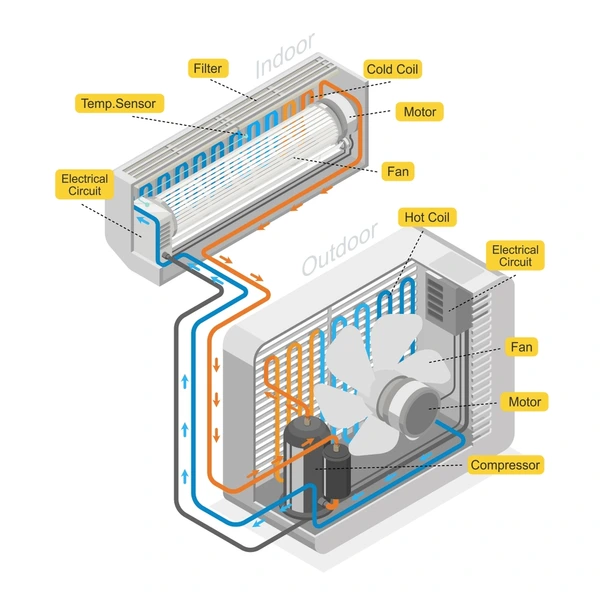
The first decision is system type. This is determined by your property size, the number of rooms you want to cool, and your budget.
Single-Split System
A single-split system connects one outdoor compressor to one indoor unit. It is the most straightforward and cost-effective option for cooling a single room — a bedroom, study, or small living area. If you only need one room cooled, this is the right starting point.
Multi-Split System (System 2, 3, 4, or 5)
A multi-split system connects one outdoor compressor to multiple indoor units — typically two to five. This is the standard choice for most Singapore homes. One outdoor unit is more aesthetically clean (important for HDB ledge space and condo MCST rules) and reduces the number of outdoor units to install and maintain.
As a general guide for HDB flats:
- 3-room HDB: System 2 (2 indoor units) — living room and master bedroom
- 4-room HDB: System 3 (3 indoor units) — living room plus 2 bedrooms
- 5-room or EA HDB: System 4 (4 indoor units) or System 3 if one room is rarely used
- Condo or landed: System 4 or System 5 depending on layout; VRF/VRV for large landed properties
VRV / VRF System
Variable Refrigerant Volume (VRV) or Variable Refrigerant Flow (VRF) systems are designed for large homes and commercial spaces. They allow individual zone control across many indoor units connected to a single system. The upfront cost is significantly higher, but long-term energy savings and precise zone control make them the preferred choice for large landed properties, offices, and F&B outlets.
Step 2: Choose the Right Aircon Size (BTU / Horsepower)
Aircon capacity in Singapore is measured in BTU/hour (British Thermal Units) or horsepower (HP). Choosing the wrong capacity is one of the most common and costly mistakes — an undersized unit runs continuously without reaching your set temperature, while an oversized unit short-cycles and fails to properly dehumidify the room.
The correct size depends on your room area, ceiling height, number of windows, and sun exposure. The table below provides a reliable starting point for standard Singapore residential rooms with 2.8–3m ceiling height:
| Room Size (sq ft) | Room Size (sq m) | Recommended Capacity | Approx. HP |
| Up to 100 sq ft | Up to 9 sq m | 9,000 BTU | ~1.0 HP |
| 100–150 sq ft | 9–14 sq m | 12,000 BTU | ~1.5 HP |
| 150–250 sq ft | 14–23 sq m | 18,000 BTU | ~2.0 HP |
| 250–400 sq ft | 23–37 sq m | 24,000 BTU | ~2.5 HP |
| 400–600 sq ft | 37–56 sq m | 30,000 BTU | ~3.0 HP |
| 600 sq ft and above | 56 sq m and above | Multiple units recommended | — |
Important: If your room faces west (afternoon sun), has large windows, high ceilings above 3m, or houses multiple occupants regularly, size up by one tier. An accurate BTU calculation should be done during a site survey — always request one before confirming your unit.
Step 3: Inverter vs Non-Inverter — Which Is Right for You?
The inverter vs non-inverter question is one of the most common ones we hear. The short answer for Singapore: if you use your aircon more than 6 hours a day, an inverter model will save you more in electricity than the price premium you pay upfront — typically recovering the difference within 18 to 36 months.
| Feature | Inverter Aircon | Non-Inverter Aircon |
| How it works | Compressor speed varies continuously to maintain temperature | Compressor turns on/off in fixed cycles |
| Energy efficiency | 30–50% more energy-efficient under sustained use | Less efficient; higher electricity consumption |
| NEA Energy Label | Typically 3–5 ticks | Typically 1–3 ticks |
| Noise level | Quieter — compressor does not stop/start abruptly | Louder cycling noise |
| Temperature consistency | Very consistent — minimal fluctuation | Slight temperature fluctuation between cycles |
| Upfront cost | Higher (S$400–800 more per unit typically) | Lower |
| Best for | Daily use of 6+ hours, bedrooms, living rooms | Rarely used rooms, budget-constrained situations |
In Singapore, where aircons run year-round, the inverter premium is almost always justified for primary rooms. Non-inverter units remain viable for guest rooms or storerooms used infrequently.
Step 4: Read the NEA Energy Label
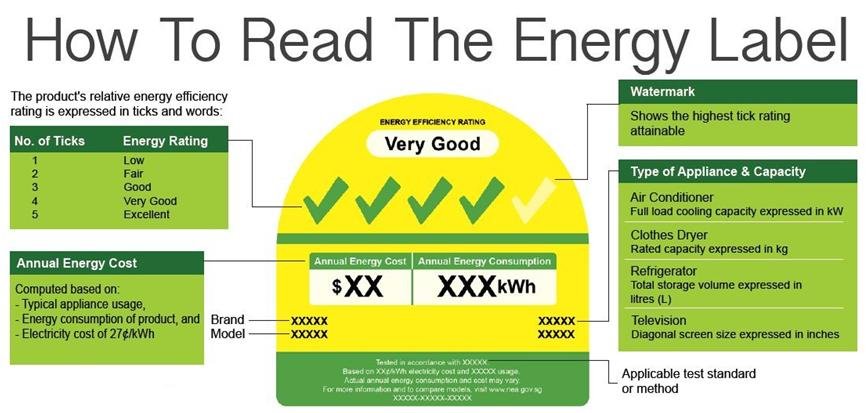
All air conditioners sold in Singapore must carry the National Environment Agency (NEA) Mandatory Energy Labelling Scheme (MELS) label. This label shows the unit’s annual energy consumption in kWh and a star rating from 1 to 5 ticks.
A 5-tick unit uses significantly less electricity than a 1-tick unit of the same capacity. When comparing models, use the annual energy consumption figure (kWh/year) rather than the star rating alone, as the rating scale varies by capacity class. At Singapore’s current residential electricity tariff of approximately S$0.32–0.36 per kWh, even a 500 kWh annual difference between two models costs S$160–180 extra per year per unit.
The practical rule: for a bedroom aircon you use nightly, prioritise 4 or 5 ticks. For a utility room or occasional use, 3 ticks is reasonable.
Step 5: Which Aircon Brand Should You Buy in Singapore?
Singapore’s market is dominated by Japanese brands, which have a strong reputation for reliability and after-sales support. Here is a factual comparison of the major brands available:
| Brand | Reputation in SG | Strengths | Typical Price Tier |
| Daikin | Market leader in SG | Wide range, strong inverter efficiency, excellent local support | Mid to Premium |
| Mitsubishi Electric | Top-tier reliability | Quiet operation, durable compressors, good energy ratings | Mid to Premium |
| Mitsubishi Heavy | Strong value brand | Solid build quality, competitive pricing vs Electric range | Mid |
| Panasonic | Well-regarded | Good energy efficiency, strong cooling performance | Mid |
| Samsung | Growing market share | Smart features, wind-free tech, modern aesthetics | Mid to Premium |
| LG | Solid performer | Dual Inverter technology, competitive energy ratings | Mid |
| Fujitsu | Niche/enthusiast | Excellent quiet operation, strong for bedrooms | Mid to Premium |
| Midea / Sharp | Budget segment | Affordable, decent for low-use rooms | Budget |
There is no universally ‘best’ brand — the right choice depends on your budget, energy priorities, and how long you plan to stay in the property. For long-term homeowners, Daikin and Mitsubishi Electric consistently rank highest for reliability and parts availability in Singapore. For tenants or shorter-term stays, mid-range options deliver solid performance at lower cost.
5 Common Aircon Buying Mistakes to Avoid in Singapore
- Choosing based on unit price alone: A cheaper unit with a higher electricity rating will cost more over 3–5 years than a moderately priced inverter model. Factor in NEA label energy consumption when comparing total cost of ownership.
- Skipping the site survey: Room dimensions on a floor plan do not account for sun exposure, ceiling height, or heat load from adjacent rooms. A proper site survey ensures you get the right capacity. Reputable installers provide this free of charge before quoting.
- Overlooking installation quality: The same unit installed poorly — wrong piping gradient, inadequate pressure test, incorrect refrigerant charge — will underperform and require early repairs. BCA-certified installers with a workmanship warranty are non-negotiable.
- Ignoring HDB or MCST rules: HDB flats and condominiums have specific rules on outdoor unit placement, trunking, and wall penetration. Non-compliant installations may need to be redone at your cost.
- Not asking about warranty coverage: Air conditioner manufacturers typically provide a 1-year parts-and-labour warranty and a separate 5-year compressor warranty. Your installer’s workmanship warranty (separate from the manufacturer warranty) should cover at least 90 days on all installation work.
Pre-Installation Checklist: What to Confirm Before Your Appointment
Once you have chosen your unit and booked your installer, confirm the following before installation day:
- Site survey completed and BTU/system sizing confirmed in writing
- Final quote issued and accepted — including piping length, electrical isolator, and any concealed piping scope
- BCA certification of technicians confirmed
- Installation day and time confirmed in writing
- For HDB: outdoor ledge access confirmed; inform family about drilling noise
- For condo: MCST notification completed if required by your estate
- Workmanship warranty terms confirmed (minimum 90 days)
- Post-installation HDB documentation submission confirmed (installer to handle)
Frequently Asked Questions
How do I know what size aircon to buy for my room in Singapore?
Is inverter aircon worth it in Singapore?
What aircon brand is best for Singapore?
What is the difference between a System 2 and System 3 aircon?
How many ticks should my aircon have in Singapore?
What should I ask my aircon installer before booking?
Installing a New Aircon? Talk to City Cooling First.
City Cooling has completed over 5,000 aircon installations across Singapore since 2018. We offer free site surveys, transparent all-inclusive quotes, BCA-certified technicians, and a 90-day workmanship warranty. All major brands installed.
Call: 6362 2796 | WhatsApp: 9890 9677 | Book: citycoolingengr.com.sg/contactus/