Singapore’s equatorial climate forces air conditioners to work harder than almost anywhere else on earth. With temperatures consistently between 31°C and 34°C year-round and relative humidity regularly exceeding 85%, the average Singapore household runs its aircon between 8 and 12 hours daily. That level of demand makes regular aircon servicing not a recommendation — it is a maintenance requirement.
This guide answers every question Singapore homeowners, HDB residents, and condo owners ask in 2026 about aircon servicing: what each service type actually involves, how much it costs, which warning signs demand urgent attention, and what credentials to verify before you allow anyone near your unit.
| Quick Answer: How often should I service my aircon in Singapore? Every 3 months for heavy users (8+ hours daily). Every 4 months for moderate users (4–8 hours). Every 6 months for light users (under 4 hours). Singapore’s humidity accelerates dust and mould buildup faster than temperate climates, making quarterly servicing the standard for most households. |
1. Why Aircon Servicing in Singapore Is Different From Other Countries
Temperate countries can often service air conditioners once a year. Singapore cannot. Three climate factors combine to accelerate wear and contamination in local units:
- Singapore units do not have an off-season. A unit running 365 days accumulates roughly 4× the operational hours of a unit used only in summer months. Year-round heat load:
- Humidity above 80% creates ideal conditions for mould and bacterial growth inside the evaporator coil and drain pan. Aspergillus and Cladosporium mould species — both linked to respiratory issues and worsened asthma — thrive in warm, damp aircon interiors within weeks of cleaning. Persistent high humidity:
- Dense urban environments introduce higher levels of fine particulate matter (PM2.5) to filter systems, accelerating clogging and reducing airflow efficiency. Urban air particulates:
The practical result: an evaporator coil left unserviced for six months in Singapore accumulates biofilm that reduces heat exchange efficiency by 20% to 40%. This forces the compressor to work harder, increasing electricity consumption and accelerating component wear.
2. Which Aircon Service Do You Actually Need? A Decision Framework
Not every aircon problem calls for the same solution. The most common mistake Singapore homeowners make is either over-servicing (paying for a chemical overhaul when a general clean suffices) or under-servicing (accepting a surface clean when the unit has deep internal contamination). Use the descriptions below to identify the right service for your situation before booking.
For a full explainer on each service type and how they work mechanically, see our dedicated guide: Discovering Different Types of Aircon Services (citycoolingengr.com.sg/blogs/discovering-different-types-of-aircon-services/).
General Servicing (Standard Clean)
General servicing is the baseline maintenance every aircon unit requires every 3 to 4 months. A properly performed standard service takes 30–45 minutes per unit and covers:
- Air filter removal, cleaning, and reinstallation
- Evaporator coil surface cleaning (fin brushing and low-pressure rinse)
- Drainage pipe inspection and flushing to prevent water leaks
- Condenser unit exterior check and debris clearance
- Refrigerant pressure visual check
- Thermostat and cooling function test
What it does not include: partial unit dismantling, deep coil chemical treatment, or blower wheel cleaning. A general service completed in under 15 minutes is almost certainly skipping critical steps.
Chemical Wash
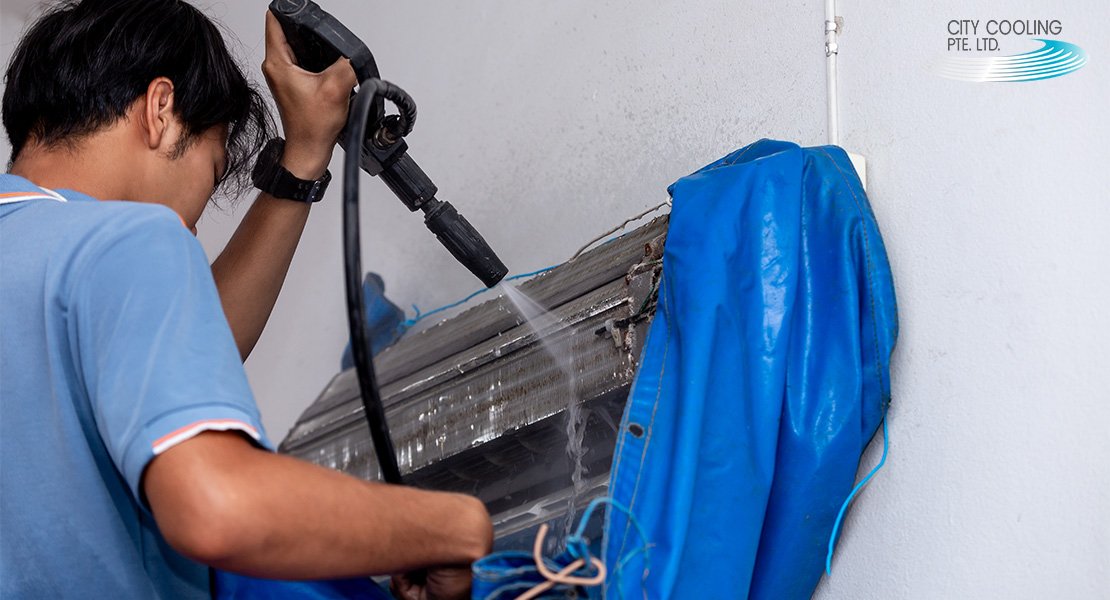 A chemical wash goes significantly deeper than standard servicing. The technician partially dismantles the indoor unit to access the evaporator coil, fan blower, and drainage tray, then applies a specialist chemical solution to dissolve stubborn biofilm, mineral scale, and deep-seated grime that surface cleaning cannot reach. Recommended every 12–18 months for most Singapore residential units, or sooner if the unit is leaking or producing musty odours.
Chemical Overhaul
A chemical overhaul is the most comprehensive service available. The entire indoor unit is fully dismantled — fan coil, blower wheel, drain pan, and housing — soaked and scrubbed with chemical solutions, then reassembled. This is the correct service for units with recurring leaks, severe mould contamination, or significantly reduced cooling performance. City Cooling SG’s chemical overhaul includes a 90-day workmanship warranty.
| Service Type | What’s Dismantled | Recommended Interval | Price Range (SGD) |
|---|---|---|---|
| General Servicing | Nothing (surface only) | Every 3–4 months | $45 – $80 per unit |
| Chemical Wash | Partial (coil, drain pan) | Every 12–18 months | $80 – $150 per unit |
| Chemical Overhaul | Full dismantle | Every 2–3 years or when needed | $150 – $350 per unit |
| Gas Top-Up (R32/R410A) | N/A (refrigerant only) | When cooling drops | $80 – $200 per unit |
Note: Prices reflect 2026 market ranges in Singapore. Cassette and ceiling-concealed units carry higher labour costs due to access complexity. Always request an itemised quote before work begins.
| Need more detail on chemical overhaul?For a comprehensive breakdown of what a chemical overhaul involves step-by-step, how it compares to a chemical wash, and exact pricing, read our dedicated guide: Aircon Chemical Overhaul: What, When & Cost — citycoolingengr.com.sg/blogs/chemical-overhaul-what-when-how-much/ |
3. R32 Refrigerant and What It Means for Servicing in 2026

Singapore’s aircon market is mid-transition from R410A to R32 refrigerant, a shift driven by the government’s commitment to lower-GWP (Global Warming Potential) cooling agents. R32 has a GWP of 675, compared to R410A’s GWP of 2,088 — making it significantly better for the environment.
For homeowners, the practical implications are:
- R32 units require technicians with specific handling certifications. Confirm your servicing company has BCA-registered technicians qualified for R32 systems before booking.
- R32 is mildly flammable (classified A2L). Reputable companies use appropriate tools and never attempt refrigerant top-ups in unventilated spaces.
- Older R22 units are being phased out. Singapore imposes levies on R22 refrigerant to discourage refilling. If your unit still uses R22, it is worth obtaining a replacement cost estimate.
| City Cooling SG’s Position on R32:All our technicians are certified to handle R32 and R410A systems. We follow NEA and BCA guidelines on refrigerant handling, storage, and disposal — non-negotiable on every job. |
4. Five Warning Signs Your Aircon Needs Servicing Now
Most aircon failures in Singapore are preventable. These five signs indicate a service is overdue — not in 3 months, but immediately:
- Water dripping from the indoor unit. The most common complaint. Usually caused by a blocked drain pipe. Left unaddressed, it damages walls, flooring, and furniture. Contact an aircon repair specialist immediately.
- Warm or weak airflow. Indicates a dirty evaporator coil, low refrigerant, or a failing compressor. A unit blowing room-temperature air is not cooling at all.
- Musty or mouldy smell. Indicates mould or bacterial growth inside the unit. This is a health issue, not just a comfort one. A chemical wash is the minimum appropriate response.
- Unusual noises (rattling, grinding, hissing). Rattling may indicate a loose fan blade or debris inside the unit. Hissing is a refrigerant leak signal — do not ignore it.
- Electricity bill increases without change in usage. A dirty coil forces the compressor to work harder. City Cooling customers regularly report 15–20% reductions in cooling-related electricity costs after a thorough service.
5. How to Choose an Aircon Servicing Company in Singapore
Singapore has hundreds of aircon servicing companies and the quality gap between them is wide. Three non-negotiables to verify before booking any provider:
- Technicians handling refrigerants must be BCA-registered. Ask for the registration number — a reputable company provides it without hesitation. BCA registration:
- Your quote should itemise labour, chemical treatments, GST, and transport. Any provider who cannot give a written breakdown before work begins is a risk. Transparent, itemised pricing:
- A minimum 90-day workmanship guarantee is the industry benchmark. City Cooling SG’s warranty covers all services as standard. Workmanship warranty:
| Full vetting checklist →For a comprehensive 7-point checklist covering certifications, pricing transparency, service scope, emergency availability, and review verification, see: Qualities of a Good Aircon Servicing Company — citycoolingengr.com.sg/qualities-of-a-good-aircon-servicing-company/ |
6. Aircon Servicing Contract vs One-Time Service: Which Is Right for You?
A servicing contract locks in a fixed schedule — typically quarterly visits — at a discounted rate versus booking individually. For Singapore households that run their aircon daily, contracts offer two practical advantages:
- Cost savings of 15–25% per visit versus ad-hoc bookings.
- Guaranteed scheduling priority, especially important during peak demand periods (April–June, when Singapore temperatures peak).
Contracts are most cost-effective for households with 3 or more aircon units. For single-unit homes used infrequently, ad-hoc bookings may be more appropriate. City Cooling SG offers flexible annual contracts covering HDB flats, condos, and commercial properties — prices available on request via WhatsApp at 9890 9677.
7. How to Prepare Your Home Before an Aircon Service Visit
A brief preparation routine before your technician arrives makes the service faster, cleaner, and more thorough:
- Clear a 1-metre working radius around each indoor unit.
- Lay old towels or plastic sheeting on furniture and flooring directly below each unit.
- Have a power outlet accessible near each unit — technicians may need to test electrical connections.
- Note any specific problems you’ve observed (strange noises, particular units leaking) — tell the technician before they start.
- Ensure outdoor condenser units are accessible — clear any objects or plants obstructing them.
How often should I service my aircon in Singapore?
What is the difference between a chemical wash and a chemical overhaul?
Is aircon servicing legally required in Singapore?
What is R32 refrigerant and do I need a different type of service for it?
Why does my aircon smell musty after I turn it on?
How do I know if my aircon is low on gas?
What should an aircon service cost in Singapore in 2026?
Choosing City Cooling SG for Aircon Servicing in Singapore
City Cooling SG has provided aircon servicing to Singapore homeowners since 1999. Our team of BCA-registered, NEA-compliant technicians services HDB flats, condominiums, landed properties, and commercial premises across Singapore. Every service comes with a 90-day workmanship guarantee and transparent pricing with no hidden charges.
We cover all major brands — Daikin, Mitsubishi, Panasonic, LG, Fujitsu, Samsung, and more — and handle R32, R410A, and legacy R22 systems.
| Contact Method | Details |
|---|---|
| Phone | 6362 2796 / 6362 2720 |
| WhatsApp (Fastest) | 9890 9677 |
| citycoolingsingapore@gmail.com | |
| Website | https://citycoolingengr.com.sg |
| Experience | 25+ years | BCA-Registered | NEA-Compliant |
| Warranty | 90-day workmanship guarantee |


Leave a Comment